

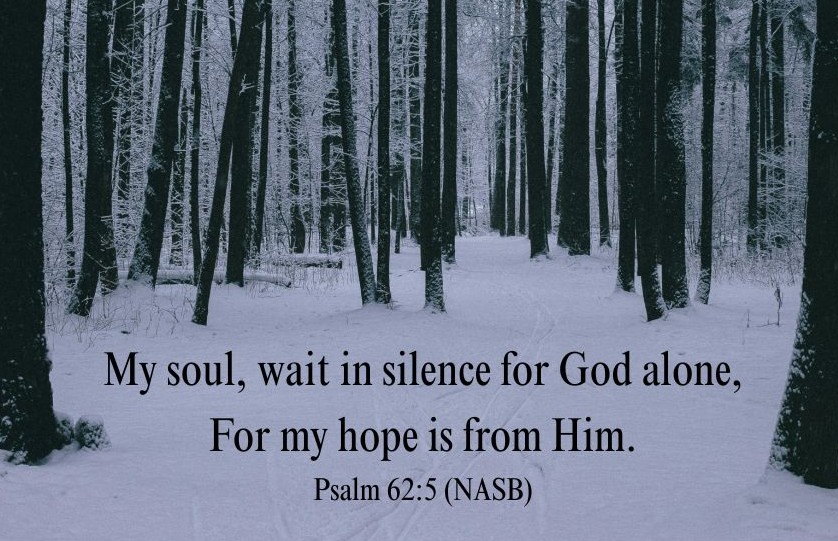
During this time of year, many may get tired of the hustle and bustle of preparing for the holidays. The Christmas carol “Silent Night” may become the wishful prayer of many a weary soul. Granted, sometimes a little peace and quiet, time to just slow down and enjoy a silent night at home, is just what a tired body and spirit need.
For others, the silence may be deafening. Living alone or having very few, if any, family members or friends to spend the holidays with can be lonely.
Then there are moments in our spiritual lives when we feel God is silent. During those moments we may cry out with desperation hoping God will give us some sign that He has not forgotten us.
As I recently began reading the beginning of the New Testament gospels and the stories of the arrival of John the Baptist and the Holy Christ Child, I thought about the 400 silent years between the Old and New Testament. I have often heard that time period, known as the Intertestamental Period, described as being a dark time, a time when God was silent among His people. Scholars describe it that way because the Bible does not record what occurred during that time. There are no manuscripts of prophets preaching or striving to share messages of “thus says the Lord.”
I never enjoyed studying history. In school, that subject was my least favorite. For the first in my life, I began digging into what really occurred during those 400 unrecorded years as far as the Bible is concerned. I found it so fascinating. I learned that a period of silence did not equate to God not working. In fact, I believe it was the opposite.
When the Old Testament ended around 397 B.C. with the Book of Malachi, the Perian Era had already begun. The Jewish people were returning to their land. It would seem the people had learned their lesson concerning worshipping false gods because the written scriptures began to hold more importance. There are no historical records to show they ever worshipped idols as a nation again.
Five other historical periods which occurred after the Perian Era ended around 336 B.C are:
The Greek Era (336-323 B.C)
The Egyptian Era (323-198 B.C.)
The Syrian Era (198-166 B.C.)
The Maccabean Era (165-63 B.C.)
The Roman Era (63-4 B.C.)
Each of those eras were significant. Each affected the Jewish people differently. Sometimes they were allowed freedom to worship. During those times of religious freedom, they placed emphasis on having a high priest to lead them more than on having a king. At other times men were put to death if it was discovered they had been circumcised, which still stood as a sign they followed God. Some were put to death if it was found they possessed the written scriptures. Through those eras, many died for their beliefs, but there always remained a remnant of those who relied on God.
Alexander the Great ushered in the Greek Era. His aim was to establish a worldwide empire that would have a unified language and customs. Because of him, the world began speaking the Greek language. That process of Greek culture infiltrating the known world was known as Hellenization.
The Old Testament, the Septuagint, was translated from Hebrew to Greek by the Jewish Scribes due to the widespread use and acceptance of the Greek language. Greek culture, beliefs, and ideas within the Jewish community was accepted by varying degrees.
The Pharisees were the group who whole-heartedly and rigidly aligned with the Law of Moses. Their zeal for obeying the Word was commendable at the beginning. However, they became so legalistic that they began writing their own laws in an effort to get people to adhere to the original scriptures. The problem then became that they put more emphasis on their oral laws, which they elevated to be more important than the meaning and intention of the original laws as given by God.
The Sadducees also arose. They were comprised more from the wealthy and social elites. They claimed their Jewish descendancy but cared more about the Hellenistic lifestyle than adhering to the Law of Moses.
There is much that happened during all of these different eras. It was during the Maccabean Era when the tradition of Hanukkah began. Think about that. The Festival of Lights began during a time we consider very dark! If you read The First Book of Maccabees, you can see how the writer credited God with the victories they won for religious freedom.
It was due to the Romans that the infrastructure of roadways was well established. That system of roadways as well as the widespread use of the Greek language allowed the spread of the Gospel easily during and after the time Christ walked the earth.
I mentioned all of these things to get to the point that hit me as I began reading the New Testament. Read the following passages concerning the announcement of the coming of John the Baptist and of Jesus:
“In the days of Herod, king of Judea, there was a priest named Zechariah, of the division of Abijah; and he had a wife from the daughters of Aaron, and her name was Elizabeth. 6 They were both righteous in the sight of God, walking blamelessly in all the commandments and requirements of the Lord. 7 And yet they had no child, because Elizabeth was infertile, and they were both advanced in years. 8 Now it happened that while he was performing his priestly service before God in the appointed order of his division, 9 according to the custom of the priestly office, he was chosen by lot to enter the temple of the Lord and burn incense. 10 And the whole multitude of the people were in prayer outside at the hour of the incense offering. 11 Now an angel of the Lord appeared to him, standing to the right of the altar of incense. 12 Zechariah was troubled when he saw the angel, and fear gripped him. 13 But the angel said to him, “Do not be afraid, Zechariah, for your prayer has been heard, and your wife Elizabeth will bear you a son, and you shall name him John. 14 You will have joy and gladness, and many will rejoice over his birth. 15 For he will be great in the sight of the Lord; and he will drink no wine or liquor, and he will be filled with the Holy Spirit while still in his mother’s womb. 16 And he will turn many of the sons of Israel back to the Lord their God. 17 And it is he who will go as a forerunner before Him in the spirit and power of Elijah, to turn the hearts of fathers back to their children, and the disobedient to the attitude of the righteous, to make ready a people prepared for the Lord.” Luke 1:5-17 (NASB)
“Now in the sixth month the angel Gabriel was sent from God to a city in Galilee named Nazareth, 27 to a virgin betrothed to a man whose name was Joseph, of the descendants of David; and the virgin’s name was Mary. 28 And coming in, he said to her, “Greetings, favored one! The Lord is with you.” 29 But she was very perplexed at this statement, and was pondering what kind of greeting this was. 30 And the angel said to her, “Do not be afraid, Mary, for you have found favor with God.” Luke 1:26-30 (NASB)
When Mary and Joseph took eight-day old Jesus to Jerusalem to present him to the priest and to offer a sacrifice, this happened:
“And there was a man in Jerusalem whose name was Simeon; and this man was righteous and devout, looking forward to the consolation of Israel; and the Holy Spirit was upon him. 26 And it had been revealed to him by the Holy Spirit that he would not see death before he had seen the Lord’s Christ. 27 And he came by the Spirit into the temple; and when the parents brought in the child Jesus, to carry out for Him the custom of the Law, 28 then he took Him in his arms, and blessed God, and said,
29 “Now, Lord, You are letting Your bond-servant depart in peace,
According to Your word;
30 For my eyes have seen Your salvation,
31 Which You have prepared in the presence of all the peoples:
32 A light for revelation for the Gentiles,
And the glory of Your people Israel.”
33 And His father and mother were amazed at the things which were being said about Him. 34 And Simeon blessed them and said to His mother Mary, “Behold, this Child is appointed for the fall and rise of many in Israel, and as a sign to be opposed— 35 and a sword will pierce your own soul—to the end that thoughts from many hearts may be revealed.”
36 And there was a prophetess, Anna, the daughter of Phanuel, of the tribe of Asher. She was advanced in years and had lived with her husband for seven years after her marriage, 37 and then as a widow to the age of eighty-four. She did not leave the temple grounds, serving night and day with fasts and prayers. 38 And at that very moment she came up and began giving thanks to God, and continued to speak about Him to all those who were looking forward to the redemption of Jerusalem.” Luke 2:25-38 (NASB)
Did you notice what I did? Zechariah was called “righteous.” Mary was told she had “found favor with God.” Simeon was described as righteous and devout, and that the Holy Spirit was upon him and had told him he would live to see the Messiah. Anna, an 84-year-old prophetess, served night and day with fasting and prayers at the temple. God had not been silent to these people! There obviously were some who had managed to stay faithful to their God. They had lived according to His Word. They were living with an anticipation of what He had promised to do over 400 years earlier!
It hit me that just because some people believe that God is not moving, He still is! During those years which Christians today describe as years of darkness and silence, God was still orchestrating His plan.
William MacDonald puts it this way in the Believer’s Bible Commentary (pg. 1091):
“This long silence was part of His eternal plan. He had spoken on numerous occasions and through various people, but He was now preparing to speak His greatest and most powerful Word to mankind: Jesus. A pause-a long and distinct pause-would add emphasis to that monumental revelation.”
This silence was not for the people actually living during that 400-year span. It was for us! Sure, they did not have the minor and major prophets preaching and writing out their accounts of God’s movements. However, through the political changes and upheavals, the chaos of their day, God still had men and priests who stood on His Word. They still explained to the people the limited scriptures they did have on hand. They still gathered together in the synagogues to try to learn how to live in a broken world. The Holy Spirit was still giving people hope to press on and look for the coming of the Messiah!
My opinion is that this period of silence is similar to Paul’s thorn in the flesh. We are not told what that thorn was so that we can learn from Paul’s statement that God’s strength is sufficient. By not knowing Paul’s specific thorn, then we can know that no matter what affliction or trial God chooses not to free us from, His strength is sufficient for us as well.
The same with the period of silence. In our limited understanding, God was seemingly silent for 400 years. So, what do we learn from that?
When God seems to be silent, continue reading and studying His Word. When we are longing for a little silence from the chaos of everything going on around us, when others are trying to force their lifestyle and culture upon us, stay faithful to God’s Word.
When we feel alone and like we have no one that sees us or understands us, know God hasn’t forgotten His own. He has a plan and is taking the time to make it perfect.
When we feel like He is far away, trust that He is working out His plan. Just as He orchestrated events so people could communicate in one language and travel easily, He is preparing a way now for His Word to be understood and widely proclaimed. Whatever He promised before He seemingly went quiet, He will still perform!
Behind the scenes of the silence, He is preparing us for the time when He will reveal Himself in an earth-moving, breath-catching way! He made a promise over 2000 years ago to us. Remain faithful – Jesus is coming!